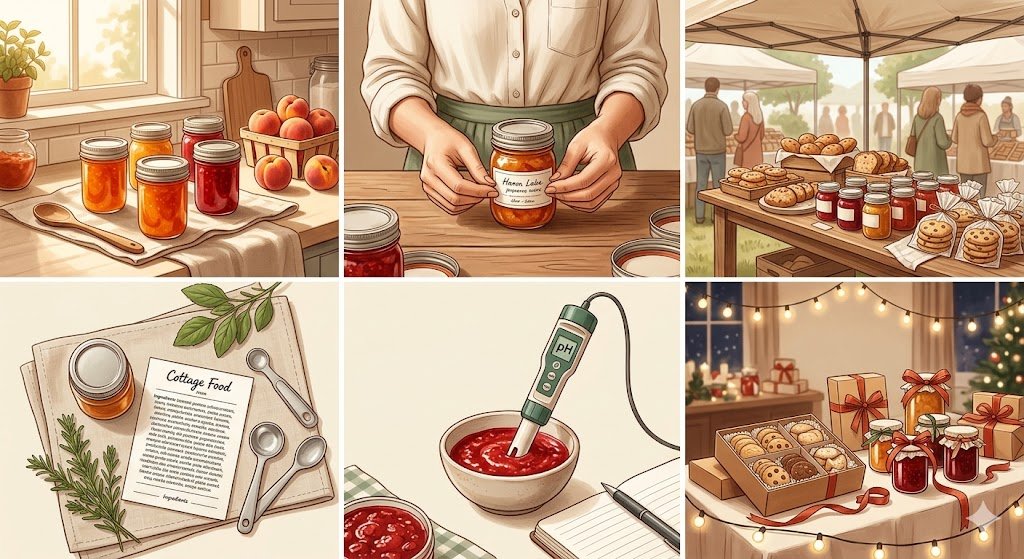
Farmers markets are the primary sales channel for cottage food sellers in most states.
Why Farmers Markets Work for Cottage Food
Farmers markets are the dominant sales channel for cottage food sellers in most states, and for good reason. Markets attract customers who specifically want locally made, handcrafted food. The prices that feel high online feel completely appropriate at a farmers market table. And the face-to-face nature of market sales perfectly satisfies the direct-consumer requirement found in most state cottage food laws.
How to Apply for a Farmers Market Vendor Space
Every market has its own application process, but the general steps are consistent:
- Find markets in your area — search for your county or city name plus "farmers market vendor application." Most markets have websites with current application deadlines.
- Prepare your documentation — most markets ask for proof of registration or licensing (if required by your state), a list of products you plan to sell, and sometimes photos of your products and setup.
- Understand the fees — market fees vary widely from $10-15/day at small community markets to $100+/day at high-traffic urban markets. Some charge seasonal flat fees. Factor this into your pricing.
- Confirm cottage food acceptance — most farmers markets welcome cottage food vendors, but some high-end markets require full commercial licensing. Ask specifically whether they accept state-registered cottage food producers.
What Markets Typically Require from Cottage Food Sellers
- Proof of state cottage food registration (if your state requires registration)
- Compliant product labels on all items for sale
- A clean, covered display — no bare food, use packaging
- Product liability insurance (some markets require this; $300-500/year through specialty food insurance providers)
- A signed market vendor agreement
Setting Up Your Market Table
Your table setup directly affects sales. Key principles for cottage food market success:
- Height and visibility — use risers, shelves, or crates to create levels. Flat tables are harder to browse.
- Labels must face customers — every product needs its label visible, including the required home kitchen disclosure.
- Samples — where markets allow sampling, offering small samples dramatically increases conversion. Check with your market about their sampling policy.
- Cash and card — a Square or similar mobile payment reader lets you accept cards. Most markets have strong cash flow, but card acceptance increases average transaction size.
- Signage — a clear sign with your business name and price list makes shopping easier and projects professionalism.
Pricing at Farmers Markets
Cottage food at farmers markets should be priced 20-40% higher than comparable grocery store items. This is not gouging — it reflects the real cost of handcrafted production and the premium experience of buying from the maker. Customers at farmers markets understand and accept premium pricing. Common anchors: cookies $2.50-4 each, small jam jars $7-10, full loaves of bread $7-12, whole pies $22-30.
FAQ
- Some markets require it; others do not. Product liability insurance for cottage food sellers runs $300-500/year through specialty providers like the Food Liability Insurance Program (FLIP) or similar. Even if not required, it is worth considering as your sales volume grows.
- Yes. There is no state rule limiting you to one market. The only limit is your production capacity and your state's annual sales cap (if applicable). Many successful cottage food sellers work two or three markets per week.
- In most states, yes — taking orders in advance and fulfilling them in person at the market is a common practice and is generally considered a direct consumer sale. The key is that the actual exchange of product and payment happens in person.