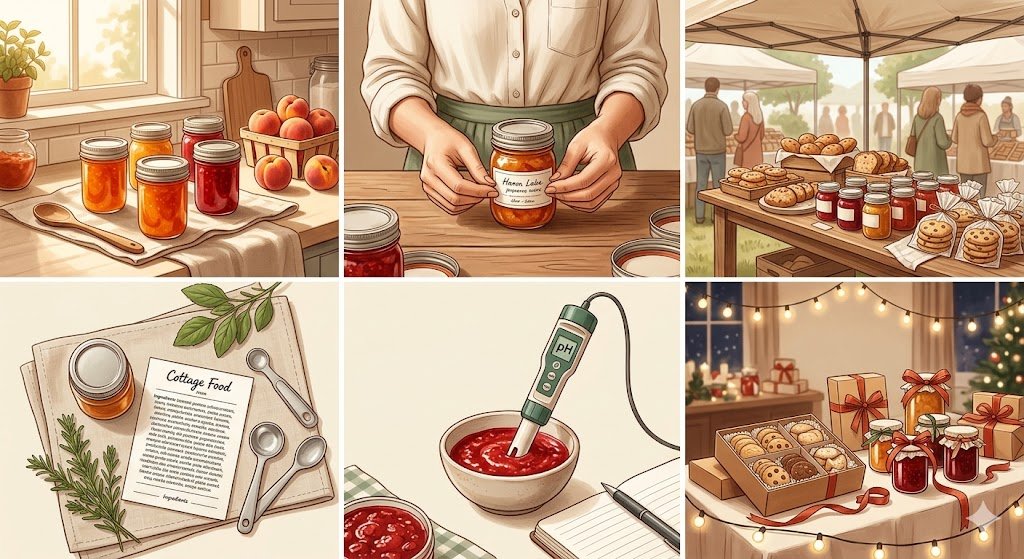
A calibrated pH meter lets you verify every batch reaches pH below 4.6 for shelf stability.
The Core Concept: TCS Foods
Every cottage food law is built around one central food safety concept: TCS — Time/Temperature Control for Safety. TCS foods are foods that require temperature control (either cold storage or hot holding) to prevent bacterial growth that could cause foodborne illness.
TCS foods are generally not permitted under cottage food law. Non-TCS foods — shelf-stable foods that are safe at room temperature — are generally permitted.
The practical test: if it needs to be refrigerated or frozen, it is almost certainly TCS. If it can sit safely on a pantry shelf indefinitely, it is probably non-TCS.
Why pH Matters
pH is the measurement of acidity on a 0-14 scale (7 is neutral; lower is more acidic). The critical pH threshold in food safety is 4.6. At pH 4.6 or below, the growth of Clostridium botulinum — the bacterium that produces the deadly botulinum toxin — is inhibited.
High-acid foods with pH below 4.6 are considered shelf-stable and are permitted as cottage food in most states. This is why jams, jellies, vinegar-based hot sauces, and high-acid pickles are almost universally permitted — they naturally achieve pH well below 4.6.
Low-acid foods with pH above 4.6 require pressure canning or refrigeration to be safe, and are generally not permitted under cottage food law.
Digital pH Meter — Essential for Jams, Hot Sauce & Pickles
If you make jams, jellies, hot sauce, or pickles, a calibrated digital pH meter is one of the most important tools you can own. It lets you verify every batch reaches pH below 4.6 for shelf stability — protecting both your customers and your legal compliance. Models with automatic temperature compensation (ATC) are accurate to ±0.01 pH.
Check Price on Amazon →Water Activity Explained
Water activity (aᴌ) measures how much free, unbound water is available in a food for microbial growth. It is measured on a scale of 0 to 1. Below 0.85, most bacteria cannot grow. Below 0.60, most molds cannot grow.
Baked goods, candy, granola, and dried products all have low water activity — which is why they are safe at room temperature. Anything with high free moisture (fresh fruit fillings, cream, custard, meat) has high water activity and is TCS.
The Two-Factor Safety Standard
The safest non-TCS cottage foods pass both tests: pH below 4.6 AND water activity below 0.85. Standard jam recipes achieve both easily. Baked goods achieve both through the baking process. This dual threshold is why these categories are permitted in all 50 states.
Practical Food Safety in Your Home Kitchen
- Keep it clean — wash hands, surfaces, and equipment before every batch
- Separate raw and ready-to-eat — never prepare cottage food products near raw meat
- Temperature control during production — even for shelf-stable products, proper cooling after baking prevents condensation and moisture buildup in packaging
- Packaging integrity — sealed packaging prevents contamination. Inspect every package before selling.
- Batch records — keep a log of ingredients and dates for each batch. If a problem ever arises, you need to know exactly what went into each product.
pH Testing Your Products
If you make hot sauce, pickles, or any acidified product, test pH with a calibrated digital pH meter — every batch. A meter accurate to ±0.01 pH is available for $30-50 on Amazon. This is not optional for serious sellers; it is both a safety practice and compliance documentation.
Calibrate your pH meter before every use using the buffer solution packets it comes with (typically pH 4.00 and 7.00 buffers). An uncalibrated meter is unreliable.